Call for Papers
Call for Papers
We invite you to join us for the Twenty-Second International Conference on Design Principles & Practices, the annual meeting of the Design Principles & Practices Research Network, hosted by the University of New South Wales, taking place in Sydney, Australia, and online.
The Design Principles & Practices Research Network is an established international meeting place for designers, researchers, educators, practitioners, policymakers, artists, architects, technologists, and community leaders working across the many fields of design. The conference welcomes proposals that address design not only as a professional practice, but as a way of thinking, making, researching, teaching, organizing, and intervening in the world.
Across the world, design is being asked to respond to increasingly complex social, cultural, ecological, and technological challenges. Key issues include climate change, social inequality, public health, digital transformation, accessibility, housing, urban life, material sustainability, artificial intelligence, visual communication, design education, and the future of creative practice. We welcome interdisciplinary proposals that engage these questions through research, practice, pedagogy, policy, community-based work, and creative experimentation.
Special Focus
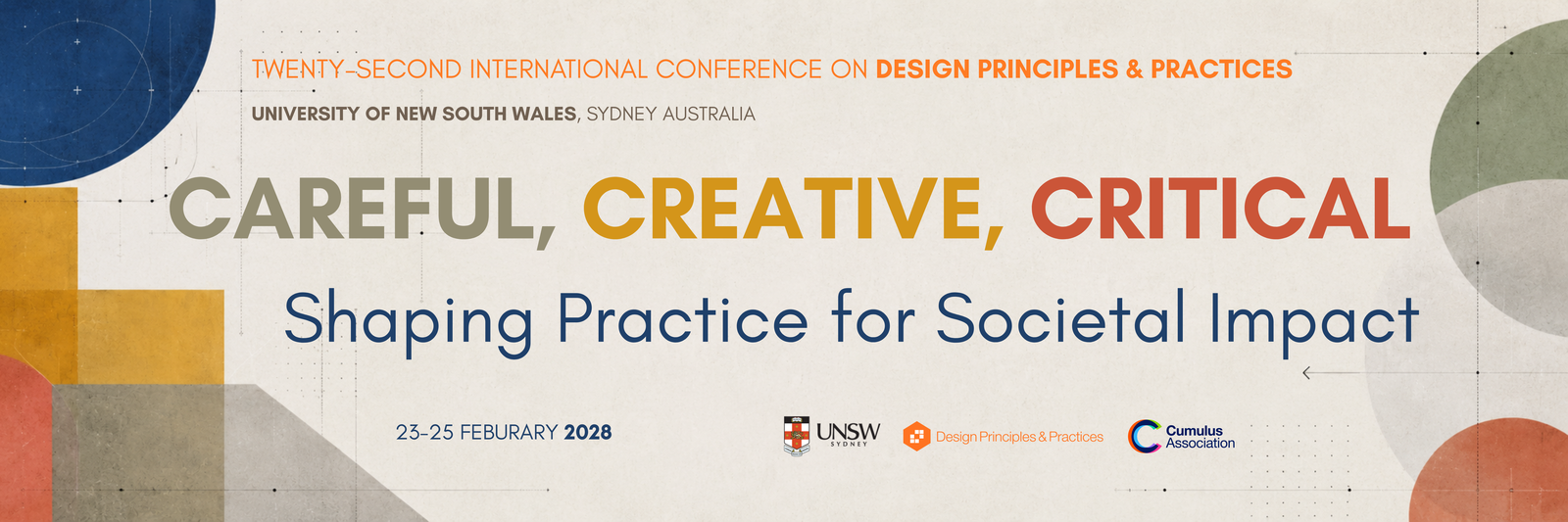
The 2028 special focus, Careful, Creative, Critical: Shaping Practice for Societal Impact, invites participants to examine how design can respond to the urgent conditions of contemporary life while remaining attentive to people, places, materials, systems, and futures.
To be careful is to design with responsibility, attention, and care for consequences. To be creative is to imagine and make otherwise, opening new possibilities for form, experience, communication, and collective life. To be critical is to question inherited assumptions, institutional systems, technological promises, and the social effects of design decisions.
Design today is not only about objects, services, images, buildings, or interfaces. It is also about relationships, infrastructures, environments, meanings, and systems of power. It shapes how people move through cities, access information, participate in communities, encounter institutions, use technologies, and imagine futures. This special focus asks how design practice can become more socially engaged, more materially responsible, more inclusive, and more capable of addressing the complex challenges of our time.
This special focus invites critical and practical conversations about the role of design in shaping social impact. How can design support care, dignity, access, and participation? How can creative practice generate new forms of knowledge and public imagination? How should designers respond to artificial intelligence, data systems, automation, and digital platforms? How can design address climate change, public space, housing, mobility, and ecological repair? What kinds of design education, research, and professional practice are needed for more just and sustainable futures?
We welcome proposals that address design as a creative discipline, a research practice, a public responsibility, and a means of social transformation.
Themes
Theme 1: Social Responsibility and Care
Theme 2: Indigenous Knowledges, Country and Futurity
Theme 3: Methods, Materials, Making
Theme 4: Technologies and Ecologies
Theme 5: Communities, Collaboration and Civic Engagement
Knowledge Experience
The conference is organized as a hybrid knowledge experience, integrating in-person and online participation within a unified scholarly environment.
For in-person delegates in Sydney, the conference is designed as a human-scale gathering shaped by conversation, shared inquiry, and place-based exchange. Sessions, talking circles, breaks, and informal encounters create opportunities to connect design research with creative practice, professional experience, education, policy, and the real-world systems that design helps to shape.
For online delegates, the conference is more than a remote viewing option. Accepted proposals become Presentation Pages where presenters share abstracts, media, and supporting materials. Delegates participate through live online sessions, asynchronous engagement, and discussion spaces that remain available before, during, and after the event.
Across both formats, the emphasis is on reciprocal exchange rather than one-way presentation. Whether joining in Sydney or online, participants are part of a shared knowledge environment where ideas can be presented, discussed, revisited, and developed into future collaborations, publications, teaching practices, design initiatives, and public conversations.
Publication Pathways
Presenters are invited to further develop their conference work for possible publication in the journals of the Design Principles & Practices Research Network, including:
- The International Journal of Design Education
- The International Journal of Design in Society
- The International Journal of Design Management and Professional Practice
- The International Journal of Designed Objects
- The International Journal of Visual Design
Participants may also propose longer-form projects for the Design Principles & Practices Book Imprint, which publishes work that advances research on design practice, design theory, design education, creative methods, sustainability, technology, public life, and social change.
Join Us
We warmly invite you to submit a proposal and join us, either in Sydney or online, for the Twenty-second International Conference on Design Principles & Practices.
Together, we will examine how design can be careful in its methods, creative in its imagination, and critical in its engagement with the world — shaping practice for societal impact.
Sincerely,
Emma Mills, Conference Chair, University of New South Wales, Australia
Alison Gwilt, Conference Chair, University of New South Wales, Australia
Jennifer L. Biddle, Local Conference Committee, University of New South Wales, Australia
Alana Clifton-Cunningham, Local Conference Committee, University of New South Wales, Australia
David Eastwood, Local Conference Committee, University of New South Wales, Australia
Jaye Early, Local Conference Committee, University of New South Wales, Australia
Chloe Cassidy, Local Conference Committee, University of New South Wales, Australia
Judith Martínez Estrada, Local Conference Committee, University of New South Wales, Australia
Loredana Di Lucchio, Research Network Chair, Sapienza University of Rome, Rome, Italy
Lorenzo Imbesi, Research Network Chair, Sapienza University of Rome, Rome, Italy
Phillip Kalantzis-Cope, Chief Social Scientist, Common Ground Research Networks, United States of America