Call for Papers
Call for Papers
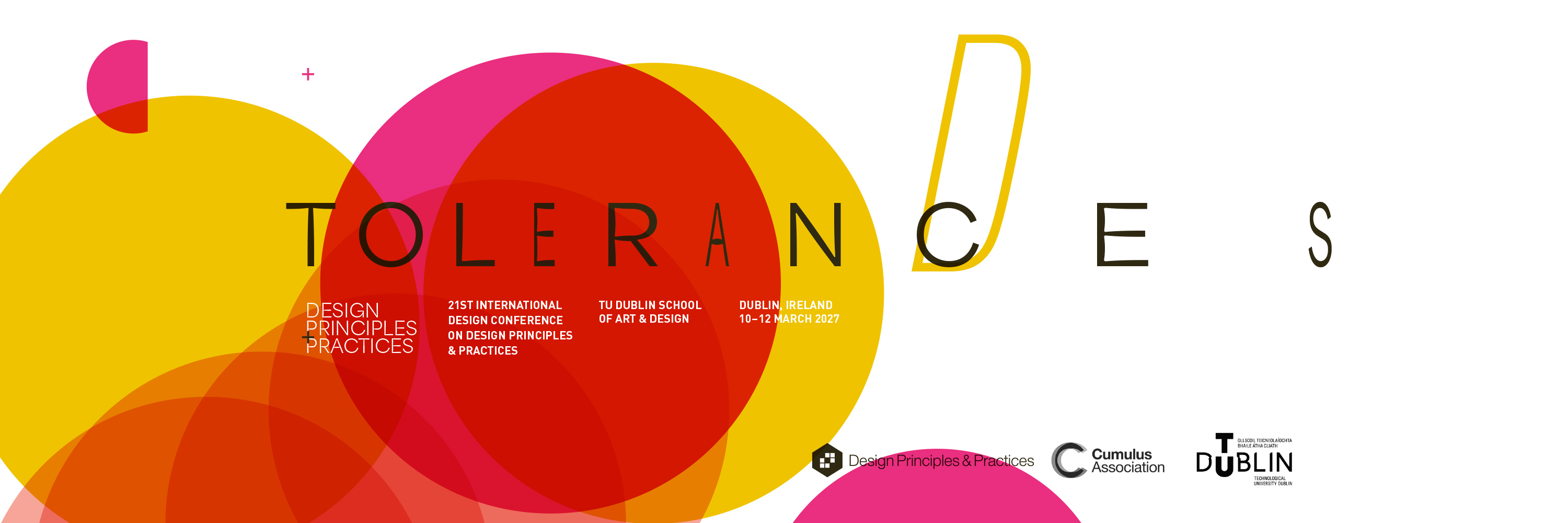
We invite you to join us for the Twenty-First International Conference on Design Principles & Practices, the annual meeting of the Design Principles & Practices Research Network, taking place 10–12 March 2027 in Dublin, Ireland, and online, in partnership with our host institution, TU Dublin School of Art & Design.
Founded as an interdisciplinary forum for exploring the meaning and purpose of design across disciplines, professions, and contexts, the International Conference on Design Principles & Practices brings together designers, architects, artists, educators, researchers, and practitioners concerned with how design operates as inquiry, collaboration, and transformation. The annual conference serves as the Network’s central meeting point for those working across interconnected disciplinary, professional, and cultural settings to address the social, cultural, technological, and environmental challenges of contemporary life.
Design unfolds between ideals and realities, rational objectivity and plural possibilities. Design Tolerances 2027 examines this delicate balance across the entire design landscape, from an idea to materiality, from systems to trust, from information to collective space through social and cultural contexts, and from the crafted to the technical or conceptual design interventions. As complexity increases across products, systems, and societies, tolerance emerges as a cornerstone of innovation, reliability, and inclusivity, as well as of peace and a respectful humanity.
Hosted in Dublin, Design Tolerances 2027 reflects Ireland’s enduring commitment to dialogue and diversity. Here, tolerance is not only a social value but a creative principle; visible in how communities balance heritage with innovation, information and language, and craft with technology.
The conference will bring together researchers, practitioners, and thought leaders to examine tolerance not only as a measure of dimensional limits but as a philosophy of design. One that defines resilience, adaptability, and responsibility in an uncertain world. Plenary sessions will examine the multi-faceted role of tolerance through diverse lenses. We will explore how design engages with difference, inclusion and pluralism across human social and cultural tolerance, addressing design’s responsibility within ecological limits, technological ethics and contemporary socio-political tensions as ecological & ethical tolerance. From blueprint to reality will reveal the design process and methods from abstract to situated and material intervention and interdisciplinarity in design. Design on the margins addresses experimentation, alternative practices and the power of working outside of dominant norms, systems and standards. Design impact facilitates discussions of frameworks and evaluation on systems change, policy, and real-world applications. The future of design pedagogies will explore how design education and profession must evolve in a transformative and uncertain future.
By convening voices from multiple disciplines, Design Tolerances 2027 seeks to redefine tolerance not as a constraint but as a catalyst for creativity, sustainability, and ethical innovation. In doing so, the conference invites designers, makers, and thinkers to reconsider how variation, difference, and adaptability shape the quality and humanity of design in an uncertain world.
Conference themes:
Social & Cultural Tolerance (exploring how design engages with difference, inclusion and pluralism across human social and cultural contexts.)
- Intercultural Communication in Design
- Participatory and Community-Centred Design
- Marginalised Communities in Design
- Empathy: Designing for Respect and Inclusion
- Accessibility, Diversity and Social Justice in Design
- Emotional Intelligence in Design
- Locality and Periphery in Design Practice
Ecological & Ethical Tolerance (addressing design’s responsibility within ecological limits, technological ethics and contemporary socio-political tensions.)
- Ecological Tolerance and Designing with Planet Boundaries
- Ethics and Responsibility in Polarised Societies
- AI and Algorithms: Designing for Fairness and Equity
- Speculative and Critical Design for Tolerant and Pluralistic Futures
- Designing with Care, Empathy and Responsibility
From Blueprint to Reality (from abstract to situated and material, methodology, and interdisciplinary methods)
- Processes and Methods: from Vision to Implementation
- Strategies of Repair, Reuse, and Degrowth
- Hybrid Approaches: Between Ethnography, Prototyping, and Co-Creation
- Scaling Design Ideas into Practice
- Materialising Design: from Drawing to Design Intervention
- Design in Action implementing Change
Designing on the Margins (experimentation, alternative practices and the power of working outside of dominant norms, systems and standards.)
- Blurring Boundaries: Art, Craft, and Design in Dialogue
- Materiality and Making as Critical Design Practice
- Measuring Tolerance: Precision, Deviation, and Design Control
- Designing through Experimentation
- Design in Non-Dominant and Informal Contexts
- Challenging the Centre: Design Beyond Norms and Standards
- Design as Resistance and Care
Design Impact (frameworks and evaluation on systems change, policy, and real-world applications)
- Evaluating Impact of Design: Frameworks and Methodologies
- Design for Transformation: From Systems Thinking to Social and Economic Change
- Governance, Policy, and Institutionalisation of Design
- Designing in Context: Rural, Urban, Environmental, and Technological systems
- Leadership by Design
Future of Design Pedagogies (explores how design education and profession must evolve in transformative and uncertain future)
- Learning Through Practice: Error, Iteration, and Embodied Knowledge
- Pedagogies of Sufficiency and Resilience
- Designing, Teaching, and Thinking for Tolerance
- Design Pedagogies and Education for iGen
- Practice of Professional Development
- Design Education for an Uncertain Future
- Public Space as a Laboratory for Change
- Regenerative Design Education
Knowledge Experience
The conference will be held in a hybrid format, combining in-person sessions at TU Dublin School of Art & Design with live online sessions and asynchronous presentations. All registered delegates—whether attending in person or online—have access to the full online program and its growing archive of presentations and discussions.
Hosted within the Network’s shared digital environment, the conference is conceived as part of an ongoing knowledge experience rather than a one-off meeting. Proposals become Presentation Pages, sessions are woven into a shared schedule, and digital media and discussion spaces support engagement before, during, and after the event. This model enables sustained, reciprocal exchange across geographies, time zones, and design disciplines.
Publication Pathways
Accepted presenters are invited to further develop their work for possible publication in the journals associated with the Design Principles & Practices Research Network. These include Design Principles and Practices: An International Journal—Annual Review, which provides a comprehensive forum for integrative and cross-cutting scholarship on the nature, meaning, and purpose of design, as well as the Network’s thematic journals: The International Journal of Designed Objects, The International Journal of Design Education, The International Journal of Design in Society, The International Journal of Design Management and Professional Practice, and The International Journal of Visual Design.
Presenters may also propose extended works for the Design Principles & Practices Book Imprint, which publishes monographs and edited collections advancing research and practice across design disciplines. All journals and book imprints offer options for traditional and Open Access publication.
Membership and Community
Membership in the Design Principles & Practices Research Network is included in all Presenter Passes, making conference participation a meaningful way to activate and extend membership throughout the year. Membership supports the ongoing work of the Network—its conferences, journals, books, and shared digital infrastructure.
Members participate in an online knowledge community that connects the full research and practice cycle: preparation, presentation, reflection, peer exchange, and publication. This shared space sustains dialogue and collaboration well beyond the scheduled conference sessions.
Join Us
We warmly invite you to submit a proposal and to join us—either in Dublin or online—for the Twenty-First International Conference on Design Principles & Practices. Together, we will explore how design tolerance can inform more inclusive, responsive, and resilient design practices in a world defined by difference, change, and interdependence.
Sincerely,
Aija Freimane, Conference Chair, TU Dublin School of Art and Design, Ireland
Con Kennedy, Conference Committee, TU Dublin School of Art and Design, Ireland
Ceri Almrott, Conference Committee, TU Dublin School of Art and Design, Ireland
Benjamin Readman, Conference Committee, TU Dublin School of Art and Design, Ireland
Brenda Dermody, Conference Committee, TU Dublin School of Art and Design, Ireland
Brenda Duggan, Conference Committee, TU Dublin School of Art and Design, Ireland
John Walsh, Conference Committee, TU Dublin School of Art and Design, Ireland